Smoke Signals: The Unscheduled Ritual That Kept Mid-Century Offices Sane
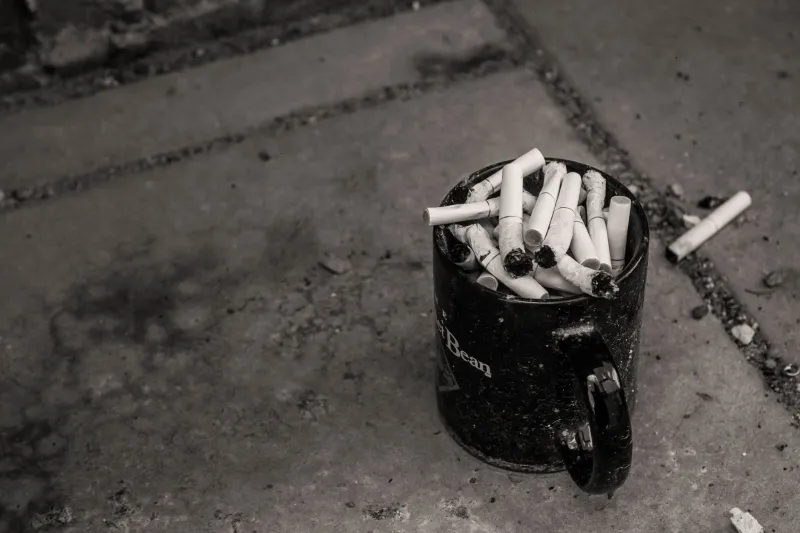
There's a scene that plays out in practically every mid-century film or television drama set in a workplace. Someone gets pulled aside — or pulls themselves aside — steps out to a stairwell, a loading dock, or a narrow strip of sidewalk, lights up, and suddenly the whole pace of the story shifts. The background noise drops. The shoulders come down. And two people who would otherwise never have had this particular conversation start actually talking.
We tend to look at those scenes now and see the cigarette. What we miss is everything around it.
The Accidental Democracy of the Back Door
Here's the thing about the cigarette break that nobody really talks about anymore: it was one of the only moments in the American mid-century workplace where the org chart stopped mattering. The VP and the file clerk were both just people standing outside in the cold, sharing a light.
That sounds small. It wasn't.
The postwar office was a rigidly hierarchical place. You didn't wander into your boss's boss's office with a half-formed idea. You didn't ask the department head what he thought about the new account over lunch — not unless you were invited. The formal structures of corporate life kept people in their lanes in ways that were efficient, maybe, but also suffocating.
The cigarette break punched a hole in all of that. It was informal by nature. You couldn't schedule it, couldn't put it on the calendar, couldn't make it official. It happened in the margins, and because it happened in the margins, it was free. Free from the performance that came with being at your desk, in a meeting, or on the floor. Free, for five or ten minutes, to just be a person talking to another person.
That kind of accidental, low-stakes connection is harder to engineer than it sounds. Plenty of companies have tried.
What Actually Got Decided Out There
Ask anyone who worked in a mid-century American office — or who worked in the kinds of blue-collar environments where cigarette breaks were practically built into the labor agreement — and they'll tell you the same thing. Real decisions happened outside. Real information moved through those informal channels. Someone heard something, passed it along, got a read on the room in a way no memo ever could have delivered.
This wasn't gossip, or at least it wasn't only gossip. It was the informal nervous system of an organization doing what formal structures couldn't: moving quickly, adapting, keeping people connected to something beyond their immediate job description.
Creative industries understood this intuitively. In the early days of the advertising world, in the record labels and film studios and newsrooms of the '50s and '60s, the best ideas rarely arrived fully formed in a conference room. They arrived half-formed, out back, between one person saying I've been thinking about this and another saying yeah, but what if—
The cigarette break was a permission structure. Permission to think out loud. Permission to be uncertain. Permission to float something before it was ready, because nobody was taking notes and nothing was on the record.
The Productivity Trap
At some point — and the timeline is fuzzy, because these shifts never announce themselves — American office culture decided that every minute needed to be accounted for. The health case against smoking was real and legitimate and the culture rightly moved away from it. But in clearing out the habit, something else got cleared out too, and we didn't notice until it was gone.
What replaced the cigarette break? In theory, nothing needed to replace it. In practice, what filled the gap was more meeting time, more structured check-ins, more scheduled collaboration. Which sounds like an improvement — intentional connection rather than accidental connection — except that intentional and accidental aren't interchangeable. They produce different things.
Scheduled collaboration is performance. You come prepared. You have a role. You're aware of who's watching and what the expected outcome is. That's useful for certain things. It is genuinely terrible for the kind of loose, associative thinking that produces unexpected ideas or honest feedback or the quiet admission that something isn't working.
The cigarette break had no expected outcome. That was the whole point.
We've Been Trying to Get It Back Ever Since
Look at the last twenty years of workplace design and culture and you'll find a long, expensive, mostly unsuccessful attempt to recreate what the cigarette break gave away for free.
Open floor plans were supposed to create spontaneous interaction. They mostly created noise and the extinction of privacy. Ping-pong tables and beer fridges were supposed to loosen people up. They mostly served as props in recruiting photos. Walking meetings, stand-up scrums, mandatory fun — all of it reaching for something that resists being scheduled or branded or put in the employee handbook.
What all of these attempts missed is that the cigarette break's power came from what it wasn't. It wasn't sponsored. It wasn't on the agenda. Nobody was measuring its ROI. It existed in the cracks of the workday, and the cracks are exactly where real human stuff tends to happen.
There's a reason the best conversations at a party happen at the end of the night, when the event is technically over and the structure has dissolved. There's a reason the most useful thing someone said to you in your last job was probably said in a hallway, not a conference room. Unstructured time isn't wasted time. It's the time when people stop performing and start thinking.
A Ritual Worth Mourning — Carefully
None of this is an argument for smoking. That case doesn't need relitigating. But the cigarette break as a concept — as a cultural technology for creating unscheduled breathing room in the middle of a pressured day — deserves a more honest eulogy than it got.
What we lost wasn't the nicotine. It was the permission to step away without justification. To be somewhere between tasks rather than always on top of them. To talk to someone without an agenda, without a follow-up action item, without the conversation being captured in a project management tool for later review.
Some workplaces have tried to recover pieces of this. The tech world's obsession with meditation rooms and nap pods is, at its core, a recognition that unstructured time produces value that structured time cannot. The growing conversation around four-day workweeks is partly about rest and partly about the same thing — giving people back the slack that productivity culture systematically eliminated.
But there's something about the communal nature of the old ritual that those individual solutions can't quite touch. The cigarette break was social. It pulled people toward each other, into a shared pause, a shared exhale. It made the margins of the workday into a place where the actual texture of a workplace — its anxieties, its humor, its unspoken politics — could surface and be acknowledged.
That's not nothing. That's, arguably, the whole thing.
The golden era of American work wasn't golden because people smoked. It was golden, in part, because the day had spaces in it. Spaces that belonged to no one, that couldn't be optimized, that just were. We filled those spaces in. We called it progress. And somewhere out back, by the door that nobody uses anymore, something is still waiting for us to notice what we left behind.