Made Slowly, Meant to Last: The Craftspeople Who Turned Time Into Their Finest Material
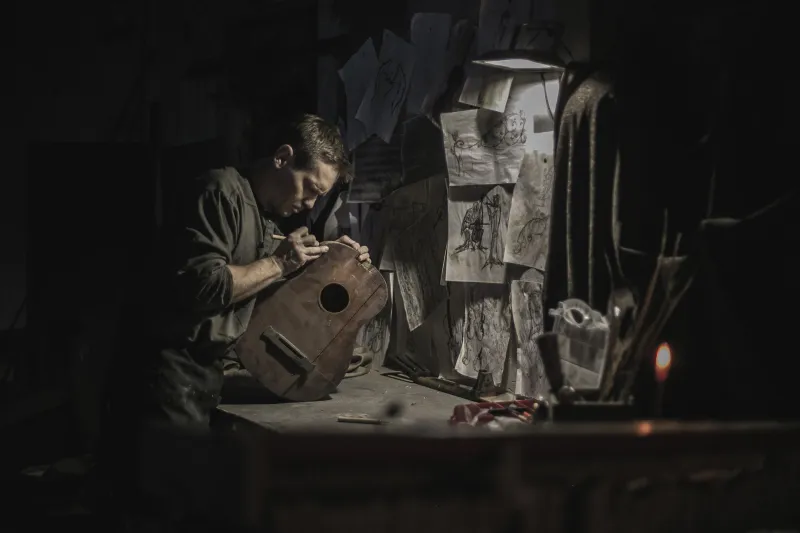
Joseph Tran has been building guitars for twenty-three years out of a workshop in Asheville, North Carolina. He makes about eight instruments a year. That number is not a constraint — it's a philosophy. Each guitar takes between six and ten weeks from first cut to final setup. He does nearly everything by hand. He selects tonewoods himself, rejecting pieces that don't meet a standard most buyers would never be able to articulate but can immediately feel when they play the finished instrument.
He has a three-year waiting list. He has never run a paid advertisement.
"I could hire help," he says, running a thumb along the edge of a half-finished spruce top. "I could probably make thirty guitars a year if I restructured things. But then I'd be running a factory, not a workshop. And the instruments would know the difference. Wood knows."
This is the language of slow craft, and it's being spoken with increasing confidence across the American artisan economy.
The Efficiency Trap
For most of the last century, speed was the unambiguous goal of manufacturing. Faster production meant lower costs, broader distribution, higher margins. The logic was airtight, and it reshaped the material world entirely. By the late twentieth century, mass production had made objects of all kinds cheaper and more accessible than any previous generation could have imagined.
What it couldn't preserve was meaning. The handmade object carries something that the machine-made one doesn't — evidence of time, of human judgment, of the thousands of small decisions that accumulate into a thing with genuine character. When you speed that process up, you don't just change how long it takes. You change what the object is.
A growing number of makers have decided that distinction matters enough to build their entire practice around it. And a growing number of buyers — many of them people who have spent years accumulating fast, cheap things and found the accumulation oddly unsatisfying — are paying attention.
Coffee, Leather, and the Long Way Around
The slow craft movement is wider than any single trade. In Portland, Oregon, a roaster named Sable Coffee operates a single-origin roasting operation where every batch is hand-turned in a vintage drum roaster and rested for a minimum of ten days before sale. Most specialty coffee rests two to four days. Sable's waiting list for their subscription service runs six months.
"The resting period changes the chemistry of the bean," explains founder Miriam Cole. "The CO2 off-gasses slowly, the sugars stabilize, the flavor profile deepens in ways that just don't happen when you rush it. Ten days is the minimum. Some of our best batches have rested three weeks." She pauses. "You can't fake that. You either wait or you don't, and the cup tells you which one happened."
In Brooklyn, a leather goods workshop called Holt & Crane produces about forty bags a year — wallets, totes, messenger bags — each assembled entirely by hand using techniques sourced from pre-industrial European saddlery. Founder Daniel Holt spent two years studying under a craftsman in Lyon before opening his own shop. His entry-level wallets start at $380. His bags run past $1,200. He sells out every season.
"People ask me why I don't use a sewing machine for the stitching," Holt says. "And I tell them: because hand saddle-stitching locks in a way that machine stitching doesn't. If one stitch breaks on a machine-sewn seam, the whole thing can unravel. With a hand saddle stitch, you can cut every third stitch and the piece holds. That's not nostalgia. That's engineering."
Time as the Rarest Luxury
Something interesting has happened in the luxury market over the last decade. The markers of genuine exclusivity have shifted. In a world where almost anything can be replicated cheaply and quickly, the thing that can't be faked is time. Hours of skilled human attention embedded in an object are, in a very literal sense, irreplaceable. You cannot automate your way to them. You cannot source them from a cheaper supplier.
This has not been lost on affluent consumers, who have grown increasingly skeptical of premium branding without premium process. The question being asked more frequently — by buyers who have the means to be discerning — is not just what is this made of but how long did it take and who decided every detail along the way.
Small makers who can answer those questions with specificity and honesty are finding that the market rewards them generously. Not the mass market — that's not the game they're playing. But a smaller, more loyal, more deeply engaged customer base that buys less and cares more.
"My customers don't buy a guitar from me and then buy another one two years later," Tran says. "They buy one instrument and play it for the rest of their lives. That's the goal. I'm not trying to build a repeat-purchase business. I'm trying to make something that doesn't need to be replaced."
The Journal Binder and the Long Arc
In Iowa City, Eleanor Marsh hand-binds journals using a Coptic stitch technique that dates to early Christian manuscript traditions. Each journal takes between four and eight hours to complete. She uses archival paper, hand-dyed linen thread, and covers sourced from a small paper mill in Vermont that still produces by traditional methods. She makes about 200 journals a year and sells every one.
"I get emails from people who've had their journals for ten years," she says. "They tell me what they've written in them. Wedding vows. Letters to their kids. Grief. The journals held all of it. That's what I'm making when I sit down to bind — a container for someone's inner life. That deserves to be done carefully."
There's something in that framing — the object as container for human experience — that gets at the deepest logic of the slow craft movement. When a thing is made with genuine care and time, it becomes capable of holding meaning in a way that disposable goods simply cannot. The journal doesn't just store words; it participates in the significance of what's written inside it.
What Slowness Signals
It would be easy to frame all of this as purely economic — a clever market positioning strategy by small producers who can't compete on volume and price. And that reading isn't entirely wrong. But it misses something.
The craftspeople who are deliberately slowing down are, almost universally, making a statement about what they believe objects should be. They're pushing back against the dominant logic of their industry — the pressure to scale, to optimize, to extract efficiency from every step of the process — because they believe that logic produces inferior things. Not just aesthetically inferior. Morally inferior, in the sense that they don't honor the relationship between maker and user.
That's a philosophical position, and it's one that's finding an audience because the alternative — a world of fast, cheap, interchangeable goods — has delivered exactly what it promised and left a lot of people feeling curiously empty.
Joseph Tran finishes his thought about the spruce top, sets it gently on the workbench, and looks out the window of his Asheville workshop.
"Every guitar I make, I wonder who's going to play it," he says. "What songs they'll write on it. What rooms it'll end up in. I don't know any of that when I start. But thinking about it — that's part of what goes into the work." He picks up a chisel. "That's what makes it worth doing slowly."