Step Into the Circle: How Ballrooms Became the Most Radical Place in America
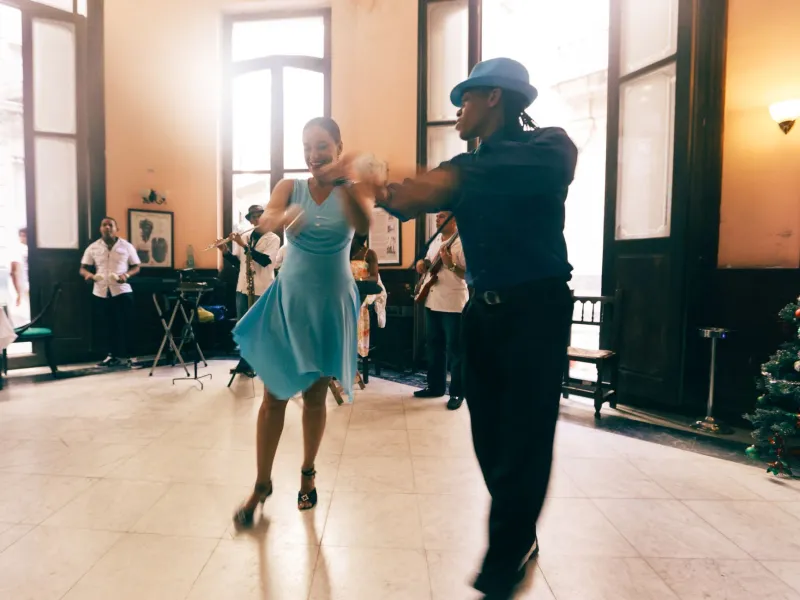
On a Thursday night in Chicago's Lincoln Square neighborhood, a converted 1940s event hall is packed wall to wall. The average age on the floor is somewhere around 27. A live band is running through a tight swing arrangement, and couples — some polished, most delightfully wobbly — are doing their best to keep up. Nobody is filming it. Nobody is checking a notification. For three hours, this room operates entirely outside the attention economy, and the people inside it look genuinely, almost defiantly, happy.
This isn't a nostalgia act. It's a movement.
The Algorithm Didn't Teach You This
There's a specific kind of exhaustion that comes from a life lived in feeds. You scroll, you consume, something surfaces, you react — and then it's gone, replaced by the next thing before you've even processed the first. Entertainment in 2024 is relentlessly personalized and utterly passive. You sit. It comes to you.
Ballroom dancing is the exact opposite of that.
You have to show up. You have to learn something. You have to make eye contact with another human being and coordinate your body with theirs in real time, with no filter, no edit, and no do-over. It's terrifying and awkward and, according to the hundreds of young Americans currently flooding into beginner swing and foxtrot classes, completely addictive.
"I tried it because my roommate dragged me," says Maya, 24, a graphic designer in Portland who now dances three nights a week. "I was convinced I'd hate it. And then I did the lindy hop for the first time with a stranger and something just clicked. It felt like the most present I'd been in months."
That word — present — comes up constantly when you talk to new dancers. Not nostalgic. Not ironic. Present.
The Venues Are Coming Back, Too
For a while, it looked like the great American dance hall was finished. The ballrooms that had anchored neighborhoods from Kansas City to Philadelphia — places where your grandparents met, where big bands played until two in the morning, where you dressed up because the room demanded it — had mostly shuttered by the 1980s, casualties of changing tastes and rising real estate costs.
But something is shifting. Venue owners and dance organizers across the country are reporting numbers they haven't seen in decades. The Turnbull AC in Birmingham, Alabama, which has been hosting swing nights since the late '90s, says attendance among first-timers under 30 has nearly doubled in the last two years. In Denver, a newly restored 1930s ballroom called The Rosewood Room sold out its opening weekend and has maintained a waitlist for lessons ever since.
"People are hungry for something that has a shape to it," says Denise Okafor, who runs a vintage dance school in Brooklyn and has been teaching since 2003. "Ballroom has rules. It has a beginning and an end. You learn it in steps. In a world where everything is fluid and formless, that structure feels almost luxurious."
Okafor has seen her enrollment triple since 2022. Her beginner Charleston class — which she half-jokingly markets as "the hardest fun you'll have all month" — now has a six-week wait.
TikTok's Accidental Gift
Here's the irony nobody quite planned for: TikTok helped start this.
Short clips of vintage Savoy Ballroom footage, mid-century foxtrot tutorials, and the kind of effortlessly cool lindy hop that makes you feel like a slob just watching — all of it has been circulating through the app's algorithm and landing on the For You pages of people who had no idea this world existed. The platform that arguably did more than anything to shrink human attention spans has, in a roundabout way, introduced an entire generation to a form of entertainment that demands sustained attention.
The catch is that you can't actually do ballroom dancing through a screen. At some point, you have to walk into a room.
"TikTok gets them curious," says Marcus Webb, who teaches swing and blues dancing in Austin. "But the second they try it in person, they realize the video was maybe ten percent of the experience. The rest of it — the music hitting your chest, the connection with a partner, the way the room smells like old wood and good effort — that's not on the app."
Webb started his Austin studio in 2019, survived the pandemic by teaching Zoom classes that he freely admits "were fine but not the same," and has since rebuilt to full capacity. His Thursday night social dance — open to all skill levels, no partner required — regularly draws over 150 people.
Romance, Ritual, and a Reason to Get Dressed
There's another dimension to this that's worth sitting with. Ballroom dancing is one of the few social rituals left in American life that still asks something of you before you walk in the door. You wear something nice. You learn at least a few steps. You ask someone to dance, face to face, and accept the answer gracefully either way.
In a dating culture dominated by swiping and ghosting, that kind of direct, embodied social interaction feels almost radical.
"I've met more interesting people at dance nights than I ever did on any app," says Jordan, 29, a teacher in Atlanta who picked up the foxtrot during a particularly rough stretch of pandemic isolation and never stopped. "There's something about learning together. You're both vulnerable. You're both kind of bad at first. It levels everything out."
The instructors and venue owners we talked to all echo a version of this. Ballroom creates a context for human connection that doesn't require a profile, a bio, or a carefully curated set of photos. You just show up and move.
The Floor Is Open
None of this means ballroom is suddenly mainstream. It's still a niche, still something you have to seek out, still a little intimidating if you've spent your whole life convinced you can't dance. But that's almost the point. The people finding their way to these floors aren't doing it because it's easy or because an algorithm served it to them. They're doing it because they went looking for something real.
The golden era of the American ballroom wasn't just about the dancing. It was about what the dancing made possible — community, ritual, physical joy, the particular electricity of a room full of people all doing the same hard, beautiful thing together. Somewhere along the way, we convinced ourselves we'd outgrown all that.
Turns out we just missed it.
The band's still playing. The floor's still open. All you have to do is walk in.