Side One, Track One: The Quiet Revolution of Listening to the Whole Damn Record
Something is shifting in the way people are choosing to listen. Not louder, not faster — just fuller. A growing number of music fans are sitting down with complete albums from start to finish, treating the experience less like a playlist and more like a novel nobody asked them to speed-read. No skipping. No shuffling. No letting the algorithm decide what comes next. Just the record, in sequence, the way the artist intended.
It sounds almost radical when you say it out loud. In 2025, it kind of is.
The Algorithm Took the Wheel, and Some People Want It Back
Streaming platforms are extraordinary at one thing: giving you more of what you already like, forever, with zero friction. You don't have to think. You don't have to wait. The next song arrives before the last one has finished exhaling. It's convenient in the way a drive-through is convenient — fast, functional, and almost completely forgettable by the time you've pulled back onto the highway.
But here's the thing about frictionlessness: it erases context. When you pull a single track out of an album and drop it into a workout playlist between a hip-hop banger and a pop anthem, you're not really hearing the song anymore. You're hearing a sound. The emotional architecture the artist built around it — the track that set it up, the one that followed it down — all of that disappears. You're left with a note, not a sentence.
And a growing number of listeners, particularly younger ones who grew up entirely inside the streaming era, are starting to feel the absence of that architecture. They're going looking for it.
What a Concept Album Actually Does to You
There's a reason artists like Kendrick Lamar, Beyoncé, and Phoebe Bridgers have leaned hard into the concept album format in recent years. To Pimp a Butterfly, Lemonade, Punisher — these aren't collections of songs. They're arguments. They build, shift, contradict themselves, and resolve in ways that only work if you stay in the room for all of it.
Kendrick's records, in particular, are designed like legal briefs. Pull one track and you've got evidence. Listen to the whole thing and you've got a case. The sequencing isn't decorative — it's load-bearing. Track three only hits the way it does because of what track two just told you. The final song lands differently because you've been through everything that preceded it.
This is what the slow-burn album does that no playlist can replicate: it changes you incrementally, scene by scene, the way a good film does. You're a slightly different person by the time it ends than you were when it started. That transformation requires patience. It requires you to stay.
The Ritual Is the Point
Ask anyone who's made whole-album listening a habit and they'll describe it in similar terms. There's a ritual quality to it. You pick the record deliberately. You put your phone across the room or at least face-down. You sit — or lie on the floor, or settle into a specific chair that has become associated with this particular kind of attention. You press play.
What happens over the next forty minutes or so is something that's hard to explain to someone who hasn't done it intentionally in a long time. The music fills the room differently when you're not braced for a skip. You notice transitions. You catch lyrics you've walked past a dozen times. The record breathes.
This isn't nostalgia for nostalgia's sake. It's not about pretending you live in 1971 and the only option is to flip the record at the halfway point. It's about choosing a different relationship with the music — one where you're a participant in the listening rather than a passive recipient of whatever the platform serves next.
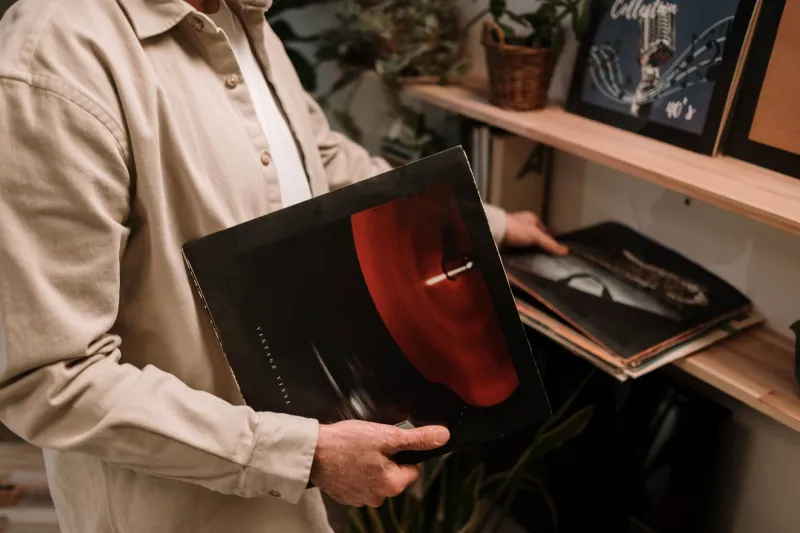
Vinyl culture has obviously fed this. When you've paid thirty dollars for a pressing and taken the trouble to lower the needle, you're not skipping to track six. The physical commitment enforces the attentional one. But plenty of people are doing it digitally too, pulling up an album on Spotify or Apple Music and just... letting it run. No queue. No radio mode. The whole thing, in order, with the lights low.
The Artists Are Noticing
Producers and musicians who care about the long form are paying attention to this shift. There's been a quiet return to sequencing as craft — thinking hard about not just which songs belong on a record, but what order they appear in and why. The interstitial moments, the brief instrumental passages, the way one song's final chord resolves into the opening of the next — these details matter again in a way they maybe didn't when everyone assumed listeners would cherry-pick anyway.
Some artists are even pushing back against the platform norm of releasing singles ahead of albums specifically to preserve the experience of hearing a record whole for the first time. They want the sequence to land intact. They want the surprise of track seven to still be a surprise. That's a gamble in an attention economy that rewards constant pre-release content drops, but it's a gamble some are willing to make.
There's also a renewed appreciation for the album as a physical object — the liner notes, the artwork, the way a gatefold opens. These elements exist in conversation with the music. They're part of the experience the artist designed. Treating an album as a streaming playlist strips all of that away. Treating it as an artifact restores it.
Patience as a Small Act of Defiance
Here's what's interesting about the whole-album listening revival: it doesn't require a manifesto. Nobody's organizing around it. There's no hashtag campaign demanding that platforms change their recommendation engines. It's just people, quietly, making a different choice about how they want to spend forty-five minutes.
But that choice carries weight. In a cultural moment defined by velocity — faster content, shorter attention spans, infinite scroll — deciding to sit with a single artistic statement from beginning to end is a genuinely countercultural act. It's saying, in the most low-key way possible, that you'd rather go deep than wide. That one thing done fully is worth more than ten things done partially.
The golden era understood this instinctively. Miles Davis didn't sequence Kind of Blue for shuffle mode. Marvin Gaye didn't build What's Going On to be broken apart. The artists who created the records we still talk about decades later were thinking about the whole experience, because they trusted that listeners would show up for it.
Some listeners are showing up for it again. They're pressing play on track one, putting their hands in their laps, and letting the record do what it was always supposed to do.
That's not a small thing. That's the whole thing.