Shelves Don't Lie: How Vinyl Collectors Turned Their Records Into Self-Portraits
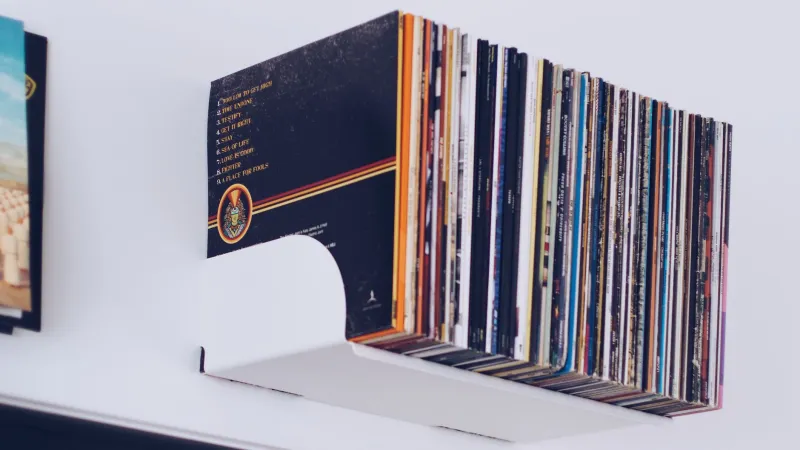
There's a moment every serious record collector knows. You walk into someone's place for the first time, and before you've even sat down, you're already reading them — cover by cover, row by row, the spines telling you something no Instagram bio ever could. That stack of Blue Note pressings near the window. The battered Joni Mitchell tucked between two Coltrane LPs. The single Dolly Parton record standing alone, unapologetic, at the end of the jazz section.
You know more about this person now than their LinkedIn profile could explain in ten paragraphs.
That's the thing about vinyl collections in 2025. They've quietly become something else entirely — not just a way to listen to music, but a way to be someone. A living, breathing self-portrait built out of cardboard sleeves and pressed wax.
The Playlist Is Dead. Long Live the Collection.
Streaming gave us everything, and in doing so, made everything feel like nothing. When you've got sixty million songs available on demand, the act of choosing doesn't carry much weight. You can skip, shuffle, abandon. There's no commitment, no consequence, no skin in the game.
Vinyl collectors opted out of that bargain.
For people like Marcus T., a 38-year-old graphic designer in Chicago who's spent fifteen years building a collection that now occupies an entire spare bedroom, the appeal was never just about sound quality — though he'll happily talk your ear off about warm low-ends and analog warmth. It was about ownership with intention.
"Every record in there, I made a decision," he says, gesturing toward a wall of floor-to-ceiling shelving that looks less like a storage solution and more like a gallery installation. "I found it, I bought it, I brought it home. That record has a story attached to it that a Spotify playlist never will."
His collection is organized not alphabetically, not by genre, but by what he calls "emotional geography" — records grouped by the periods of his life they represent, the places he bought them, the people he was with. Moving through the shelves is, for him, something close to flipping through a photo album.
Display as Discipline
The aesthetics of how collectors display their records has become its own conversation — one happening loudly in subreddits, at record fairs from Brooklyn to Portland, and in the growing number of collector-focused YouTube channels where people do room tours the way influencers used to do closet tours.
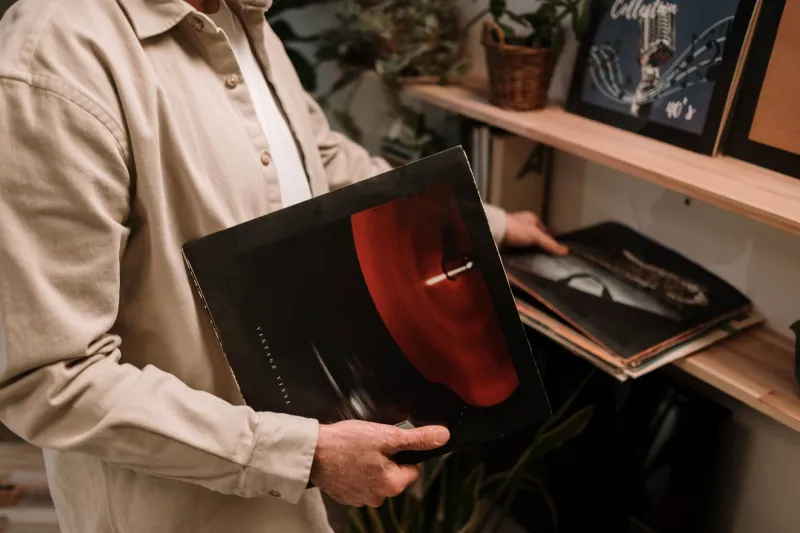
Some collectors go minimal — clean pine shelving, records organized with museum-level precision, nothing on the walls competing for attention. Others go full shrine: vintage turntable on a mid-century credenza, framed original pressings mounted above the setup, a reading lamp casting amber light over everything. The look is less "man cave" and more "jazz club back office."
Natalie R., a 29-year-old teacher in Atlanta who started collecting during the pandemic, describes her setup as "the one room in my apartment that feels completely mine." She's got about 400 records, displayed on open shelving she built herself, with a rotating selection of covers propped up front-facing like bookstore recommendations.
"I switch out the front-facing ones based on my mood, what I'm listening to, what's going on in my life," she says. "It's kind of like curating a tiny gallery show that only I see. Except when people come over, and then it's the first thing everyone wants to look at."
That front-facing display trick — borrowed from record store culture — has become one of the collector community's most common rituals. It's a way of saying: this one matters right now.
The Psychology of Owning Something Real
There's a concept in psychology called "extended self" — the idea that the objects we own become extensions of our identity. Our stuff, in other words, is part of who we are. Researchers have been writing about this since the 1980s, but it feels newly relevant in an era when so much of what we consume exists only as data.
Vinyl collectors are, consciously or not, pushing back against the dematerialization of culture. When everything is a file, nothing has weight. A record has weight — literal, physical, undeniable. You can hold it. You can read the liner notes. You can look at the label spinning under the needle and feel the mechanical reality of music being made from a groove in a piece of plastic.
That tangibility matters in ways that go beyond nostalgia.
"I think people are starving for things that are real," says Derek O., who runs a small record shop in Denver and has watched his customer base skew younger every year for the past decade. "Not real in a philosophical sense — just physically, actually real. Something you can drop and it'll make a sound when it hits the floor. Something that takes up space."
His shop hosts monthly listening sessions where people bring in records they want to share, play a side or two, and talk about why the album matters to them. It started as a small thing. Now it fills the store.
Crates as Curriculum
For a certain kind of collector, the collection is also an education — a self-directed curriculum in music history that no streaming algorithm could replicate. Digging through crates at a flea market in Philadelphia or a thrift store in Nashville, you encounter records you'd never have thought to search for. You buy something because the cover is interesting, or because it's on a label you've been trying to learn, or because the guy next to you at the bin says trust me, just take it.
That serendipity is irreplaceable. And it produces collections that feel genuinely personal rather than algorithmically optimized.
Marcus puts it plainly: "My collection doesn't reflect my taste. It is my taste. There's a difference."
He's right. A playlist is a snapshot. A collection is a life's work — dusty, imperfect, and absolutely, stubbornly yours.