Red Light, Real Light: The Darkroom Photographers Who Left the Algorithm Behind
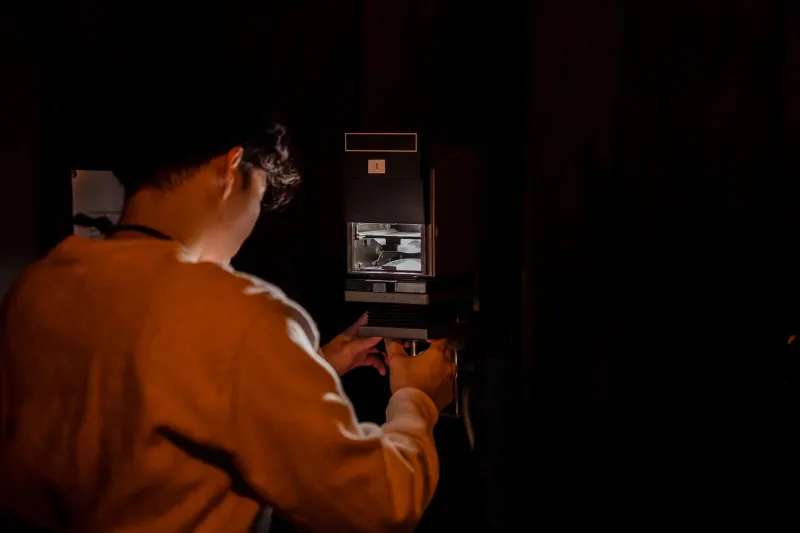
The smell hits you before anything else. Developer, stop bath, fixer — a chemical combination that's essentially unchanged since the 1880s and that anyone who's spent real time in a darkroom can identify instantly, even years later, even in a completely different context. It's the smell of patience. Of process. Of a craft that refuses to be rushed.
Somewhere in Chicago, a 26-year-old named Priya is standing in the red-tinged dark, watching an image slowly materialize in a tray of developer. She shot the roll on a Minolta SRT-101 she bought for forty dollars at a flea market. She mixed the chemicals herself. She set the timer herself. And right now, she is doing absolutely nothing except watching and waiting, which is, she'll tell you, the entire point.
"You can't multitask in a darkroom," she says. "The process won't let you. That's not a flaw. That's the whole thing."
What Film Actually Costs You
Let's be honest about the friction involved. Shooting on film means buying rolls that cost anywhere from eight to twenty dollars apiece, depending on the stock. It means either paying a lab to develop them or setting up your own chemistry at home. It means waiting — sometimes days — to see what you actually got. It means accepting that some frames will be lost to exposure errors, light leaks, or the simple reality that you had twelve, twenty-four, or thirty-six shots and you had to make them count.
For photographers who grew up shooting digital, this friction is the feature, not the bug.
The algorithmic logic of digital photography pushes toward volume. Shoot everything. Edit later. Post the best one. The camera in your phone is specifically engineered to eliminate the possibility of a bad shot — computational photography, HDR processing, AI-assisted focus — all working together to produce technically correct images at a rate of hundreds per hour if you want. And most people do want that. But a growing contingent has decided they want something else entirely.
"When I'm shooting film, I'm making decisions," says Marcus, a working photographer in Atlanta who splits his time between commercial digital work and personal film projects. "I'm thinking about light, about distance, about whether this moment is worth a frame. That slows me down. And slowing down is what makes me actually see."
The Underground Lab Scene
What's particularly interesting about the current analog photography revival is how communal it's become. Community darkrooms — shared spaces where members pay monthly dues for access to enlargers, chemistry, and printing equipment — have been opening in cities that haven't had them in decades. Seattle, Austin, Philadelphia, Minneapolis. Some are attached to art schools. Others operate as genuine co-ops, member-run and collectively maintained.
These spaces function as something between a workshop and a social club. People show up to print and end up staying for hours, looking at each other's work, trading technique, arguing about developers. The conversation that happens in a darkroom is different from the conversation that happens online, because everyone present is doing something with their hands and their full attention. Distraction isn't really an option when you're watching a print develop and the timing matters.
"It's the only place I go where nobody's looking at their phone," says Jenna, who helps run a community lab in Philadelphia. "Not because there's a rule against it. Just because you can't. The red light makes screens impossible to read, and honestly, nobody wants to. They're too busy doing the actual thing."
The Case for Grain
Film photography has a visual signature that digital has spent decades trying to replicate and never quite managed. Grain — the random distribution of silver halide crystals that creates texture in a film image — is fundamentally different from the digital noise that appears in low-light digital captures. Grain is organic. It varies across the frame. It has a quality that photographers describe as alive.
There's a reason every major photo editing application includes a "film grain" filter. There's a reason Instagram built its entire early identity around filters that mimicked analog processes. The visual language of film photography is so deeply embedded in how we understand "good" images that the industry has been trying to synthesize it for thirty years.
But synthesis isn't the same thing as the real thing, and photographers who've worked extensively with both will tell you the difference is immediately apparent, even to untrained eyes. There's a depth and tonal range in a well-exposed, well-printed silver gelatin print that a digital image printed on inkjet paper simply doesn't achieve. It's not nostalgia talking. It's physics.
The Patience Problem
The harder argument — and the one that comes up most often among serious analog practitioners — is about what the process does to you as a creative person, not just what it does to the images.
Film photography is a discipline. It demands that you develop technical knowledge you can't outsource to software. You need to understand exposure — really understand it, not just let the camera guess. You need to know your film stock, your developer, your paper. You need to be able to read light with your eyes before you raise the camera. And you need to be comfortable with uncertainty, with the gap between pressing the shutter and seeing the result.
That gap — that waiting — is where a lot of photographers say something important happens. You start to remember differently. You think about the frames you took and what you were trying to capture and whether you got it right. By the time you're standing in the darkroom watching the image emerge, you've already lived with it for days. The print isn't a surprise. It's a confirmation.
"Digital is immediate gratification," Marcus says. "Film is deferred gratification. And the thing about deferred gratification is that you actually feel it when it arrives."
Where the Practice Lives
The film photography community has built a surprisingly robust infrastructure. Film stocks that seemed headed for extinction — Kodak Ektachrome, Fujifilm Velvia — have been revived in response to demand. Small-batch film manufacturers have emerged. Darkroom supply companies that were quietly winding down have found new customers. The used camera market is genuinely competitive in a way it wasn't five years ago.
Online communities are large and active, but the real energy is in person — in the community labs, the workshops, the film swaps where photographers trade rolls and develop each other's work. It's a hands-on practice that generates a hands-on community, which feels, right now, like exactly the kind of thing people are hungry for.
Priya pulls her print from the wash, holds it up to the safelight. The image is there — sharp where she wanted it sharp, soft where she let it breathe. She made it. Physically, chemically, with her own hands and her own timing. No algorithm touched it.
"This one's mine," she says, and she means it in a way that's hard to explain to someone who's never stood in a darkroom and watched something appear out of nothing.
But if you have, you already know exactly what she means.