Pass the Salt, Put Down the Phone: The Dinner Party Is Back and It Means Business
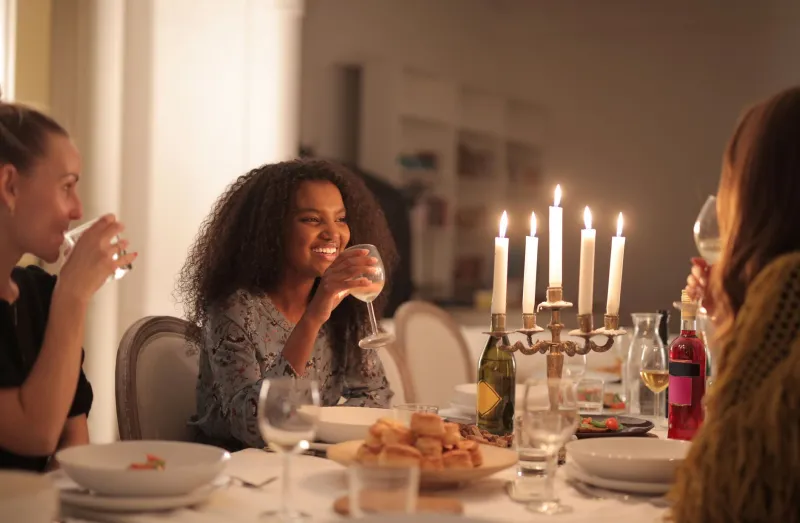
There's a moment that happens about forty minutes into a good dinner party. The first bottle of wine is mostly gone. Someone has said something genuinely funny — not tweet-funny, but the kind of funny that makes the person across from them lean forward and nearly knock over their water glass. The food is warm. The room smells like garlic and candles and effort. And for a stretch of time that nobody is measuring, everyone at that table is completely, unreservedly there.
That moment used to be ordinary. Now it feels almost radical.
The formal sit-down dinner party — the kind with a handwritten menu, a deliberate seating arrangement, and a host who spent two days thinking about what to cook — has been quietly staging a comeback. Not the influencer version with ring lights and charcuterie boards assembled for content. The real thing. The kind where someone actually thought about who should sit next to whom, where the courses arrive in an order that makes sense, and where the conversation is the whole point.
In a culture drowning in notifications and half-attention, the dinner party has become one of the last reliable places to get the full version of people.
How We Lost the Table
It's worth understanding how we got here before we talk about where we're going. The formal dinner party peaked somewhere in mid-century America — a time when hosting was considered a genuine skill, when cookbooks were aspirational literature, and when a well-set table communicated something real about who you were and how seriously you took the people sitting at it.
Then things got casual. Which isn't entirely bad — the loosening of rigid social codes opened up who got to host and who got to show up. But somewhere along the way, casual slid all the way into convenient. Dinner became a DoorDash order eaten over a laptop. Gathering became a calendar invite that half the people decline at the last minute via text. The shared meal — one of the oldest human rituals on the planet — got squeezed down into something logistical and low-stakes.
And people started feeling the absence of it, even if they couldn't quite name what was missing.
The Host as a Vanishing Art Form
Here's the thing about hosting a real dinner: it requires you to think about other people in a sustained, specific way. Not in the abstract — not the algorithmic, curated way that social media encourages — but in the concrete, material sense. What does this person actually eat? Who in this room hasn't met each other yet and would probably love each other? Is the table too bright? Is the music too loud to talk over?
That kind of attention is a skill. And like most skills that require practice, it atrophied when we stopped needing it.
But the people who are bringing it back — and there are more of them than you might think, scattered across cities and suburbs from Atlanta to Portland — talk about hosting with the same language that craftspeople use about their work. There's a satisfaction in the planning, the mise en place, the deliberate sequencing of an evening. You're not just feeding people. You're building an experience out of time and food and light and conversation, and you're doing it as a gift.
That's not nothing. In fact, in 2024, it's kind of everything.
Place Cards and the Politics of Seating
Let's talk about place cards for a second, because nothing signals intention quite like a host who has thought about where everyone sits.
The seating arrangement is where dinner party hosting gets genuinely interesting. Put the right two people next to each other and you might change the course of someone's career, relationship, or creative life. Put the wrong two people together and you've got a long evening of polite, painful small talk. The host who takes seating seriously is essentially a social architect — someone who understands that the geometry of a table shapes the flow of conversation in ways that aren't obvious until you've gotten it wrong a few times.
This is knowledge that used to be passed down. Grandmothers knew it. Social secretaries knew it. Somewhere in the mid-century American tradition of formal entertaining, it was treated as a real discipline. And now a new generation is rediscovering it, mostly by trial and error, and finding it deeply satisfying when it works.
The Multi-Course Meal as a Pacing Device
There's a reason the formal dinner moves through courses, and it's not just about the food. It's about time. Each course creates a natural pause — a moment of transition that resets the room, shifts the energy, gives people permission to change the subject or deepen the one they're already in.
The appetizer is the warm-up. The main course is where the real conversation happens, the one that goes somewhere unexpected. Dessert is the exhale, the winding down, the part where someone says something honest that they've been holding all evening.
When you compress all of that into a single platter set in the middle of the table, you lose the rhythm. And rhythm, it turns out, is a lot of what makes a dinner memorable.
The people bringing back the multi-course dinner aren't doing it to show off. They're doing it because they've figured out — intuitively or otherwise — that pacing an evening is a form of care.
What the Screen Can't Replace
Digital fatigue is real and well-documented, but what's less talked about is the specific texture of what we're fatigued from. It's not just the volume of content. It's the quality of attention that screens demand — fragmented, reactive, always slightly performative. Even our most intimate digital interactions carry that undercurrent of presentation.
The dinner table is one of the few remaining environments where that pressure mostly drops away. You can't really scroll and eat at the same time — not without being rude enough that someone will say something. The physical act of sharing food creates a kind of mutual vulnerability that screens can't replicate. You're asking someone to sit still with you for two or three hours. You're asking them to be present. And when it works, what you get back is the full, unfiltered, three-dimensional version of the people you invited.
That's the thing screens were supposed to give us more of, and somehow keep delivering less.
Feeding People Is Still the Point
At its core, the dinner party revival isn't really about aesthetics or nostalgia, though it's got plenty of both. It's about a hunger — and yeah, the pun is intentional — for the kind of connection that requires real investment.
Setting a proper table is an act of optimism. It says: I believe this evening is worth preparing for. I believe these people are worth the effort. I believe that what happens in this room tonight matters enough to cook for, to plan for, to show up for.
In a moment when so much of our social life has been flattened into content and convenience, that kind of deliberate hospitality is quietly countercultural. It doesn't make the news. It doesn't trend. It just happens, in kitchens and dining rooms across the country, among people who have decided that the ritual of feeding each other is still worth doing right.
Pass the salt. Pull up a chair. We've got a lot to talk about.