Clippers, Chairs, and the Unfiltered Truth: Why the Barbershop Is Still America's Greatest Forum
The Chair Doesn't Lie
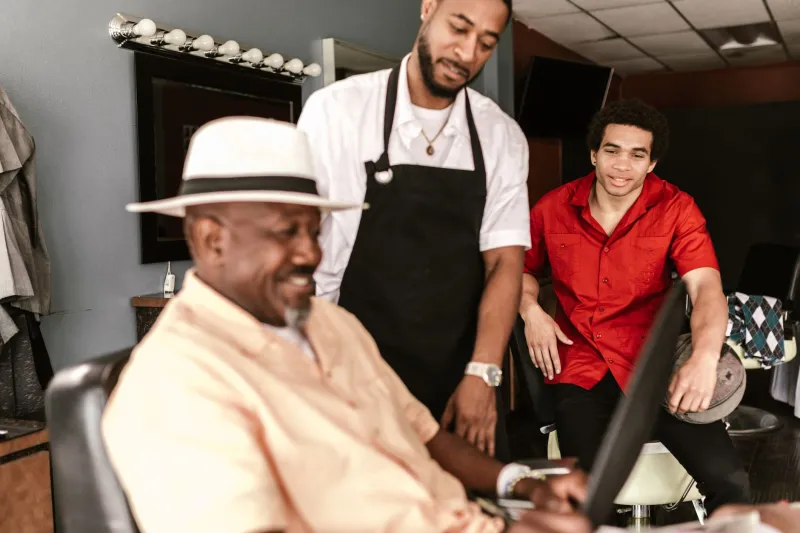
Walk into almost any barbershop in America on a Saturday morning and you'll hear something you almost never encounter online: people actually disagreeing with each other and still laughing about it twenty minutes later. Someone's got a take on the game last night. Someone else thinks that take is completely wrong. A third guy — waiting his turn, flipping through a magazine he's not really reading — chimes in with a third opinion nobody asked for. Nobody logs off. Nobody blocks anyone. The conversation just keeps moving, the way conversations are supposed to.
There's a reason the barbershop has survived every cultural shift since the mid-1800s. It isn't nostalgia, exactly. It's function. The barbershop does something that almost no other public space in modern American life manages to pull off: it brings strangers into the same room, makes them wait together, and gives them nothing to do but talk.
In an era when we've engineered nearly every inconvenient human moment out of our daily routines — grocery delivery, self-checkout, contactless everything — the barbershop stubbornly refuses to be optimized. And that refusal turns out to be a feature, not a bug.
The Third Place Nobody Talks About Losing
Urban sociologist Ray Oldenburg coined the term "third place" back in the '80s to describe the spaces that exist outside of home and work — the taverns, diners, barbershops, and park benches where community actually gets built. His argument was simple: without these spaces, social life fragments. People retreat into their private corners, and the connective tissue of a neighborhood starts to dissolve.
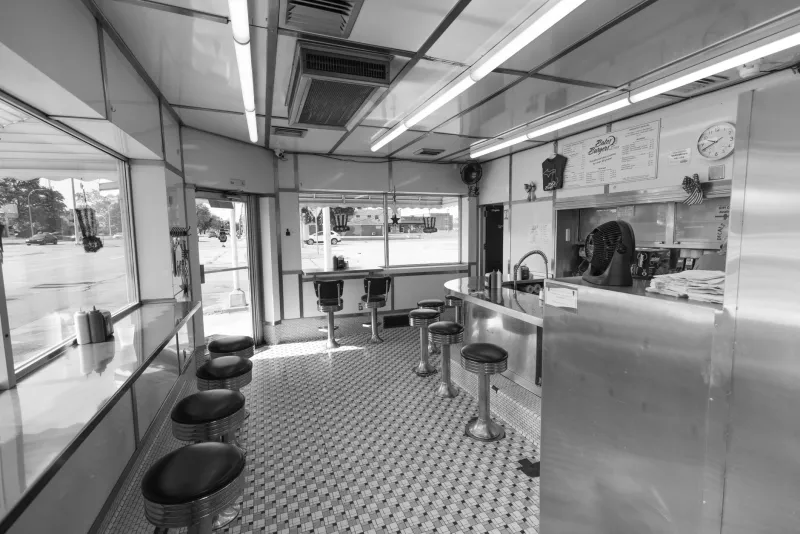
We've spent the last two decades watching that dissolution happen in real time. The corner bar got replaced by a craft cocktail lounge where nobody talks to strangers. The diner became a brunch spot with a two-hour wait and a QR code menu. The park bench got removed because someone complained. And yet, somehow, the barbershop held on.
Part of that is economic. A good haircut still requires a human being with skill and a pair of hands. You can't outsource it to an app. But part of it is something harder to quantify — a kind of cultural gravity that keeps people coming back even when they could theoretically find a cheaper, faster alternative somewhere else.
Regulars don't just return for the cut. They return for the room.
Where the Conversation Has No Algorithm
Here's what's genuinely remarkable about barbershop discourse in 2025: it operates by rules that predate the internet and, frankly, work better than anything the internet has come up with.
You can't ratio someone in a barbershop. You can't doomscroll past an argument you don't want to engage with. If somebody says something you think is dead wrong, your options are to respond, to shrug, or to stay quiet — all of which are more honest reactions than clicking a dislike button and moving on with your day.
The topics that come up in these spaces tend to be the ones that matter most to the people in the room. Sports, obviously — the barbershop has always been a courthouse for athletic arguments that never quite get resolved. But also local politics, money, family, faith, and the particular texture of life in whatever neighborhood that shop happens to occupy. These aren't abstract debates. They're grounded in the lived experience of people who know each other's names, remember each other's kids' ages, and have been watching the same block change (or refuse to change) for years.
That specificity is what makes barbershop conversation different from the generic outrage cycle that passes for public discourse everywhere else. Nobody's performing for an audience of thousands. They're just talking to the guy in the next chair.
The Barber as Institutional Memory
There's a figure at the center of all of this who doesn't get nearly enough credit: the barber themselves.
In a lot of communities — particularly Black communities, where the barbershop has historically served as one of the most important civic institutions in American life — the barber functions as something between a therapist, a historian, and a neighborhood elder. They know who moved away and who came back. They remember the businesses that used to be on this corner. They've heard every version of every argument that's come through that door over the past decade, and they've got opinions about all of it.
This isn't a new role. Black barbershops in particular have been sites of political organizing, mutual aid, and community solidarity going back to the Reconstruction era. During the Civil Rights Movement, shops across the South served as meeting places where strategy got hammered out beyond the reach of surveillance. The tradition of the barbershop as a space where power gets spoken truth to — quietly, persistently, without fanfare — runs deep.
But you don't have to look that far back to feel it. Walk into a shop that's been in the same location for twenty or thirty years and you're walking into a repository of neighborhood memory that no app is going to replicate.
What the Waiting Room Teaches You
There's also something to be said for the waiting itself.
Waiting is deeply unfashionable right now. Everything is supposed to be instant — the food, the answer, the entertainment, the validation. Waiting feels like a malfunction. And yet the barbershop wait, with its particular rhythm of idle conversation and comfortable silence and the low drone of clippers in the background, has a way of slowing a person down that's hard to find anywhere else.
You sit. You watch. You listen to other people's conversations before you join them. You learn something about the room before you start contributing to it. That's not inefficiency — that's the basic social education that used to happen in third places all the time, before we decided that friction was the enemy of progress.
Some of the best conversations in any barbershop happen between people who came in as strangers and leave as something closer to acquaintances. Not friends, necessarily. But people who've shared a room and a moment and a laugh, which is more than most of our digital interactions ever manage to produce.
The Golden Era It Never Left
At Royce 59, we spend a lot of time thinking about the things that kept their value when the culture moved on without them. The barbershop is one of those things. It didn't survive because it resisted change — plenty of shops have modernized their booking systems, updated their interiors, and adapted to new clientele without losing what made them essential. It survived because the thing it offers is genuinely irreplaceable.
A room where you can say what you think, hear what other people think, argue it out, and still shake hands on the way out the door — that's not a relic. That's a model. One we'd probably do well to remember the next time we mistake a comment section for a community.
The clippers keep humming. The conversation keeps moving. And somewhere in America right now, somebody is being told, firmly and with great affection, that their opinion on that trade is completely wrong.
They'll be back next week to argue about it some more.