Coffee, Counter Stools, and the Art of Saying What You Actually Mean
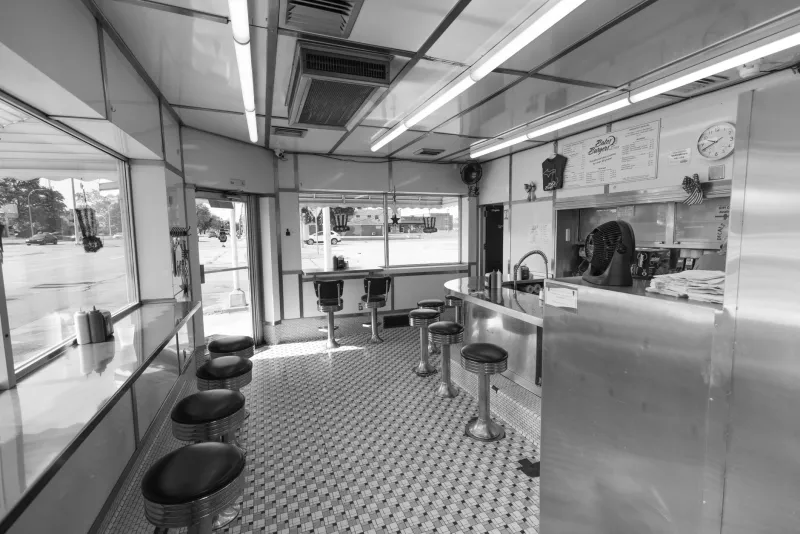
Walk into the right diner at the right hour and you'll catch something that's harder to find than you'd think: people actually talking. Not performing. Not threading a hot take for strangers on the internet. Just two or three humans, elbows on a Formica counter, voices rising and falling over something that genuinely matters to them.
It sounds simple. It isn't, anymore.
The American diner has been around long enough to outlast drive-ins, soda fountains, and the entire concept of the lunch hour. It survived the fast food explosion of the '70s, the café boom of the '90s, and the current obsession with oat milk and ambient playlists. And somewhere in that survival story is a clue about what we keep reaching back for — not just the eggs or the bottomless coffee, but the particular kind of conversation that only seems to happen in a place like that.
Why the Booth Still Beats the Feed
There's a friction to diner conversation that online debate simply cannot replicate. When you're sitting across a booth from someone you disagree with, you can see their face. You can hear the pause before they answer. You can't close the tab when things get uncomfortable.
That discomfort is the whole point.
Social media gave us the illusion of debate while quietly removing most of what makes debate worthwhile. The stakes are low when you can delete a comment. The empathy is optional when you can't see the other person blink. What diners offer — and what they've always offered — is presence. Physical, unedited, sometimes frustrating human presence.
In 1959, a diner counter was one of the few places in America where a factory worker, a teacher, and a local politician might share the same three feet of space and actually talk. Not at each other. To each other. The geography of the place demanded it. Those stools were close together for a reason.
The Architecture of Honesty
Diner design isn't accidental. The long counter forces strangers into proximity. The booths create just enough privacy for real conversation without total isolation. The noise — the clatter of plates, the hiss of the grill, the bell above the door — creates a kind of white noise intimacy. You have to lean in to be heard. Leaning in changes things.
Compare that to the modern coffee shop, which has largely been engineered for solitude. Noise-canceling headphones are basically the dress code. The furniture is designed for laptop posture, not eye contact. The whole environment signals: be here, but be alone.
Diners never got that memo, and thank goodness for it.
There's also something to be said for the menu. You're not spending twenty minutes deciding between seventeen variations of a single beverage. You order, you wait a few minutes, you eat. That efficiency keeps the conversation from stalling out. The food is almost beside the point — it's the punctuation, not the sentence.
Nostalgia That Isn't Really About the Past
When people talk about missing "the way things were," they're often not being literal. Nobody is genuinely pining for the specific year 1959. What they're mourning is a quality of experience — the sense that a conversation could go somewhere real, that an argument could end with both people changed in some small way, that human contact had weight.
Diners carry that feeling because they were built around it. They were designed for people who had limited time and wanted to use it around other people. The whole model assumes that being together matters.
That assumption has become quietly radical.
You see it in the places that have held on — the Waffle Houses scattered across the South that function as something between a restaurant and a community center, the Greek-owned diners in New Jersey that have served the same neighborhoods for fifty years, the 24-hour spots in Chicago or Detroit where the night shift crowd and the early risers briefly overlap and share a few minutes of the same world. These aren't just restaurants. They're institutions, and they're institutions specifically because they kept doing the one thing that's hardest to do at scale: making space for people to show up as themselves.
The Argument That Doesn't End in a Block
Here's what gets lost in the digital version of debate: resolution. Or at least, movement. Online arguments tend to calcify. Positions harden, audiences get involved, and suddenly the conversation isn't between two people anymore — it's a performance for everyone watching. Nobody wants to change their mind in public. The social cost is too high.
At a diner counter, the audience is the guy two stools down who's trying to eat his hash browns in peace. The stakes are lower in one sense — nobody's going viral — and higher in another, because you're still sitting next to this person when the argument runs out of steam. You might have to ask them to pass the ketchup. That proximity creates a natural pressure toward resolution, or at least toward mutual acknowledgment that you're both just people trying to figure something out.
That's not a small thing. That might be the whole thing.
What Gets Said at 2 a.m.
There's a specific quality to late-night diner conversation that deserves its own study. The defenses come down around midnight. The people who are there at that hour — the insomniacs, the after-shift workers, the couples who've been at it for hours and needed to get out of the apartment — they're not there to impress anyone. They're there because they needed somewhere to be.
And in that need, something honest usually happens.
The golden era of American culture that Royce 59 keeps circling back to wasn't golden because everything was better. It was golden because certain things were more direct. The way people dressed was a statement. The music people made was a conversation. And the places people gathered were designed to actually hold them — not just their attention, but their whole complicated, argumentative, searching selves.
The diner was always the most democratic room in America. Still is, if you can find one that hasn't been turned into a brunch spot.
The Table Is Still Set
None of this is to say that diners are perfect or that the conversations that happen inside them are always enlightened. People have been having the same arguments over diner coffee for decades — about politics, about sports, about who was right and who was wrong and what should happen next. The debates don't always resolve. Sometimes they just run out of coffee.
But they happen face to face. They happen with the possibility of interruption and laughter and the kind of tangent that completely changes the subject and somehow gets you closer to the point. They happen in real time, with real people, in a room that smells like bacon grease and possibility.
That's not nostalgia. That's just a good reason to leave the house.