Dressed to Transmit: What Your Grandfather's Suit Was Actually Saying
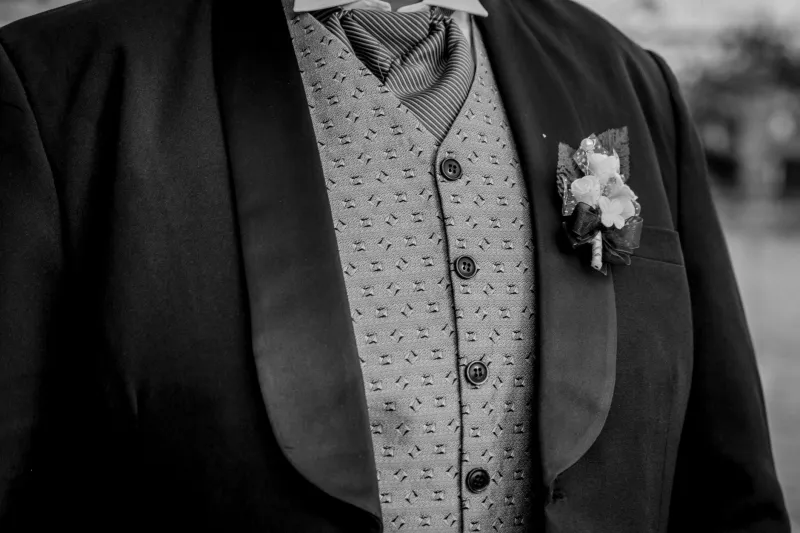
There's a photograph — you've probably seen one like it — of a man standing outside a midtown Manhattan office building sometime around 1957. He's got a cigarette in one hand, a briefcase in the other, and he's wearing a charcoal gray two-button with a chalk stripe so subtle you almost miss it. His tie is knotted with the kind of precision that suggests he did it in under thirty seconds without a mirror. He looks, in a word, settled. Not flashy. Not trying. Just completely, quietly in command.
Nobody taught us how to read that image. We just can. And that's the whole point.
The Suit as Syntax
Mid-century menswear operated on a grammar most men understood intuitively, even if they couldn't name the rules. The width of a lapel communicated decade and disposition. A peaked lapel on a double-breasted jacket said authority, maybe ambition — you were the guy at the head of the table or angling hard to get there. A notch lapel on a single-breasted two-button said something quieter: I'm here, I'm reliable, and I don't need to announce myself.
Fabric was syntax too. Wool worsted for the office, because it held a crease and resisted wrinkle — a man in pressed trousers at four in the afternoon was a man who had his situation under control. Seersucker on a summer Saturday in the South said leisure, but a particular kind of leisure — earned, unhurried, civilized. Flannel in winter said warmth and weight, a certain gravitas that lighter fabrics couldn't carry.
And color? Color was almost a dialect unto itself. Navy communicated trustworthiness, which is why it dominated banking floors from Wall Street to LaSalle Street in Chicago. Brown was controversial — some circles considered it too casual for serious business, which meant the men who wore it well were usually making a deliberate point about not needing your approval.
Jazz Clubs and the Counter-Curriculum
If corporate America had its dress code, the jazz world had its counter-curriculum — and it was every bit as precise, just pointed in a different direction.
The bebop cats of the late forties and fifties didn't reject the suit. They weaponized it. Miles Davis showing up to a gig in a sharply cut Italian suit wasn't conforming to mainstream expectations — it was a direct challenge to them. The message was layered and deliberate: We are more sophisticated than the rooms you've put us in. We are not your entertainment. We are artists.
Thelonious Monk's porkpie hat and angular sport coats were a whole other conversation — eccentric, willfully odd, signaling that genius operates outside your conventions and has no interest in apologizing for it. Dizzy Gillespie's beret became so associated with a certain intellectual seriousness that it crossed from accessory into symbol.
The jazz world proved something important: the suit wasn't inherently about submission to a system. It was a tool, and in the right hands, it could say the exact opposite of what the system intended.
The Casual Collapse
Somewhere between the 1970s and the 2010s, American men largely abandoned the language. Casual Fridays bled into casual always. The rise of Silicon Valley's deliberate anti-fashion — hoodies, jeans, and sneakers as a power move of their own — convinced a generation that dressing with intention was either pretentious or irrelevant.
And look, there's something to be said for comfort. Nobody's here to shame a man in a good pair of chinos. But something genuinely got lost in the translation. When everyone is wearing the same uniform of studied nonchalance, the ability to communicate anything specific through clothing evaporates. You become visually anonymous. A gray hoodie says nothing about you except that you own a gray hoodie.
The irony is that in trying to escape the perceived conformity of the suit, American men largely landed in a different conformity — one with fewer options and less expressiveness, not more.
The Guys Who Never Forgot
There's a subculture — it doesn't have a clean name, which is part of its appeal — of American men who kept the faith. You find them in barbershops with straight-razor shaves in Nashville and New Orleans. You find them in the corners of menswear forums online debating the ideal gorge height on a lapel with the same energy other people bring to fantasy football. You find them at estate sales, holding up a 1962 Brooks Brothers jacket to the light and checking the shoulder seam with the focus of a jeweler examining a stone.
These guys aren't cosplaying. They're not nostalgic in a passive, wistful way. They understand that precision dressing is a form of respect — for the occasion, for the people around them, and for themselves. They've figured out what their grandfathers knew instinctively: that how you present yourself is a choice, and choices communicate.
The Modern Recalibration
What's interesting right now — and genuinely interesting, not just trend-piece interesting — is how many younger men are finding their way back to tailoring. Not because some magazine told them to, but because they've grown up in a world of such extreme visual sameness that the idea of wearing something specific feels almost radical.
Custom shirting shops in cities like Atlanta, Austin, and Philadelphia are reporting a steady uptick in clients under forty. Bespoke tailors who assumed their client base would age out are finding new customers who saved up for their first made-to-measure suit the way a previous generation saved for a first car. Vintage menswear — particularly American and Italian pieces from the fifties and sixties — has gotten genuinely expensive at auction, which is what happens when something goes from overlooked to understood.
The appeal isn't purely aesthetic. It's philosophical. A well-cut suit requires you to know something about yourself — your proportions, your context, your intentions for the day. It asks you to be deliberate in a moment when deliberateness feels increasingly rare.
What the Cloth Still Carries
Here's the thing about a language: it doesn't die just because fewer people speak it. It waits. The grammar of mid-century menswear — the lapel widths, the trouser breaks, the pocket squares folded with studied casualness — is still fully operational. It still communicates. It still reads.
When a man walks into a room in a suit that fits him correctly, with fabric that has actual weight and construction that didn't happen in a factory in forty-five seconds, people feel it before they process it. Something registers. Something that says: this person thought about this. This person is present.
Your grandfather knew that. The jazz musicians knew it. The tailors on Savile Row and the side-street shops in Chicago knew it.
The code never went anywhere. It's just been waiting for more people to remember how to read it.