No Signal Required: The Rooms Where Real Power Still Gets Decided
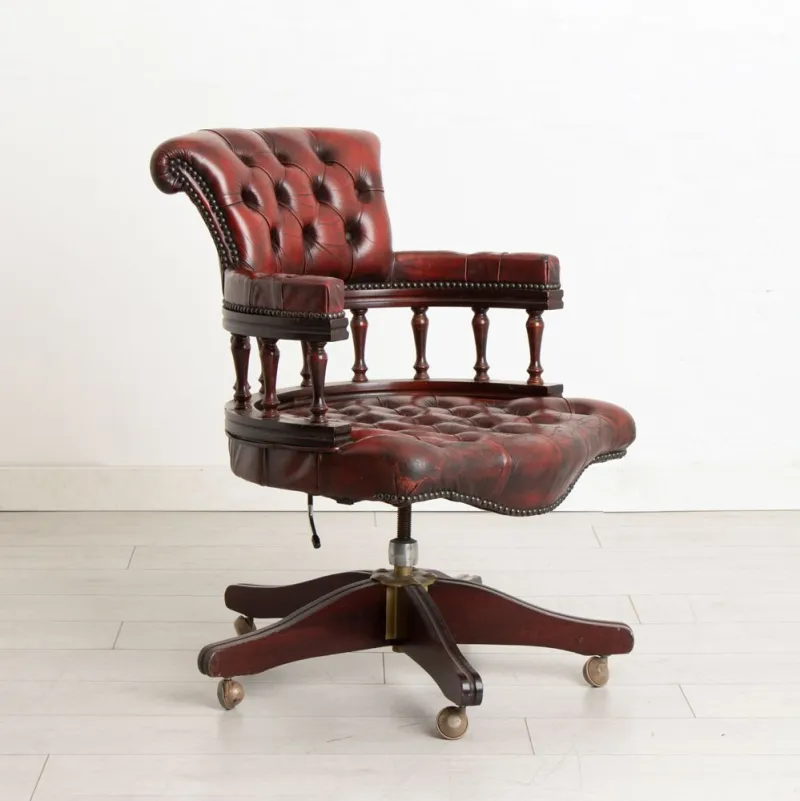
Photo: vintage boardroom leather chairs mahogany table mid-century office meeting, via theoldcinema.b-cdn.net
There's a particular kind of quiet that settles over a room when something important is about to happen. Not silence exactly — more like a held breath. The hum of a climate control unit. The soft drag of a chair across carpet. A glass of water nobody's touched yet. If you've ever been in that room, you already know what we're talking about. And if you haven't, no video call is going to simulate it for you.
For all the tech we've layered onto modern professional life — the shared docs, the async updates, the endless parade of calendar invites — the rooms where things actually get decided look a lot like they did in 1959. Four walls. A table. People who showed up in person because they understood, on some level, that presence is its own kind of argument.
The Boardroom Never Really Went Hybrid
During the pandemic, we told ourselves a convenient story: that physical proximity was a relic, a habit dressed up as necessity. Productivity consultants wrote breathless pieces about the liberation of distributed work. And for a lot of tasks — the reporting, the coordinating, the moving of information from one inbox to another — they weren't wrong.
But ask anyone who's closed a major deal, navigated a hostile acquisition, or talked a creative partner off a ledge at the eleventh hour. They'll tell you the same thing: it happened in a room. Not on a call. Not over email. In a room, across a table, with someone whose hands they could see.
There's a reason the most consequential negotiations in American history — labor agreements, peace talks, political horse-trading — have always been conducted face to face. It isn't nostalgia. It's neurochemistry. Human beings are wired to read micro-expressions, track body language, and calibrate trust in real time. Compression artifacts and a two-second lag don't just make that harder. They make it functionally impossible.
The Analog Advantage Nobody Wants to Admit
Here's something the productivity-tech industry would rather you not dwell on: the most persuasive thing you can do in a negotiation is simply be there. Physically. Fully. Without the escape hatch of a mute button or a minimized window.
When you're in the room, you can't multitask your way out of discomfort. You can't quietly draft a response email while someone makes their case. You're accountable to the moment in a way that a screen fundamentally undermines. And the other side of the table knows it. That accountability — that mutual exposure — is precisely what makes the conversation real.
Old-school dealmakers understood this intuitively. The backroom wasn't just a location. It was a technology. A tool for creating conditions where people had to be honest, because there was nowhere else to look.
The great mid-century power brokers — the studio heads, the union chiefs, the political fixers — didn't build their influence through memos. They built it through presence. Through the cultivated art of reading a room and knowing exactly when to lean forward and when to let the silence do the work.
What the Screen Takes Away
Let's be direct about something: remote communication is extraordinarily good at transferring information. It is genuinely terrible at building trust.
Trust is tactile. It lives in the handshake that lasts a beat too long, in the eye contact that doesn't flinch, in the willingness to sit in the same room with someone and let them see that you're serious. You cannot manufacture that through a webcam. You can approximate it, maybe. On a good day, with good lighting and a decent connection, you can get somewhere in the neighborhood of it. But the neighborhood isn't the destination.
Creative collaborations suffer especially. Ask any film director, any record producer, any architect who's tried to run a major project entirely through screens. The ideas that actually catch fire — the ones that turn into something worth making — almost always trace back to a moment of physical co-presence. Someone scribbling on a whiteboard. Someone pacing the room. Someone saying wait, hold on and grabbing a pen.
The screen flattens the creative process in the same way it flattens everything else. It turns three-dimensional human exchange into a series of rectangles.
The Rooms That Still Run the World
Walk through the lobbies of the law firms, the private equity offices, the entertainment agencies that still matter in this country. Notice what's missing. The rooms where the real conversations happen — the ones with closed doors and no windows into the hallway — don't have screens on the walls. They have art. Or nothing. Just space.
That's not an accident. The people who built those rooms understand something that gets lost in the enthusiasm for digital transformation: the absence of distraction is itself a form of power. When you strip away the notifications, the feeds, the ambient noise of the connected world, what's left is just people. And people, it turns out, are the whole game.
Politics works the same way. The most consequential moments in any legislative session, any campaign, any diplomatic negotiation, happen in rooms that never make it onto C-SPAN. The cameras capture the performance. The rooms are where the decisions get made.
The Lost Art of Showing Up
There's something almost countercultural about it now — choosing to be somewhere in body, not just in bandwidth. Insisting on the meeting that could have been an email, not out of inefficiency, but out of respect for what's actually at stake.
The golden era of American business and culture wasn't built on convenience. It was built on presence. On the understanding that some things require you to look someone in the eye and let them look back. That the friction of physical space — the commute, the handshake, the coffee that goes cold while you're arguing — isn't a bug. It's the whole point.
When we talk about the rooms where power lives, we're not being romantic. We're being accurate. The algorithm doesn't close the deal. The spreadsheet doesn't build the alliance. The Zoom call doesn't make the ask that changes the trajectory of a company or a career.
The room does.
And the room is still there, waiting. Quiet. Patient. Ready for whoever's willing to show up.